The Measurement Problem Has a Simple Explanation
There is a debate running through every serious technology publication right now. Enterprises have spent tens of billions of dollars on AI tools. Researchers, analysts, and executives are trying to measure the productivity gains. The evidence is weak. The methodology is contested. The conclusions are mixed.
The debate is unresolvable. Not because the measurement tools are inadequate. Because the thing being measured is not the thing that was purchased.
Most enterprise AI spending is not a productivity bet. It is career insurance, purchased by individual executives, paid for with company money, and wrapped in productivity language because that is the only vocabulary the budget approval process accepts.
Once you see that structure, everything else makes sense: why the ROI projections are always forward-looking and safely unverifiable, why baselines are almost never captured before deployment, why spending persists even when the productivity story is weak, why deployment is uniform across industries with wildly different actual AI use cases. None of that is confusion or incompetence. It is the rational behavior of people managing personal career risk with organizational capital.
What the Behavioral Evidence Shows
The strongest evidence for the career insurance thesis is not a survey. It is the behavioral fingerprints: the observable patterns that only make coherent sense under this explanation.
The ROI is always 24 months forward. Enterprise AI spend commitments are almost never accompanied by pre-deployment baseline measurement, and the productivity projections are systematically placed beyond the current performance review cycle. This is not a coincidence of timing. If the purchase were a genuine productivity bet, you would expect the buyer to instrument the baseline aggressively, to create the measurement conditions that would prove the thesis. Instead, the standard pattern is: deploy first, hope the gains appear, attribute whatever optimizes.
The baseline is almost never captured. Major management consulting surveys of AI-adopting enterprises consistently find that fewer than a third of companies can cite a specific, measured productivity gain tied to AI deployment with a controlled baseline. This is not a resource problem. Capturing a pre-deployment baseline costs two weeks of analyst time. Organizations that genuinely need cost savings (that are making a real productivity bet) run pilots with baselines because they need the data to make the next decision. Organizations that are buying for other reasons do not, because the baseline was never the point.
Spending is uniform across wildly different competitive situations. A consumer packaged goods company faces a completely different AI disruption timeline than a fintech. A government contractor operates in a different regulatory environment than a software startup. Yet AI spending, particularly on horizontal productivity tools like Copilot, ChatGPT Enterprise, and Claude, is broadly uniform across all of them on a per-seat basis. If risk mitigation or competitive pressure were the primary driver, you would expect spending to concentrate in industries with the highest threat. It does not. The spending pattern looks like a tax, not an investment thesis. A uniform cost of participating in a specific institutional environment.
Deployment does not follow use case availability. Companies deploy AI enterprise licenses organization-wide, including to functions like HR, legal, facilities, and finance, where the documented use cases are thin and the prior spending on comparable productivity tools was low. A genuine productivity buyer would identify the highest-ROI workflows and start there. Instead, the dominant deployment pattern is all-hands licensing followed by internal campaigns to generate usage. The tool purchase precedes the use case identification. That is the signature of a legitimacy purchase, not an operational optimization.
Spending does not decline when productivity gains fail to materialize. Enterprise software with weak demonstrated ROI gets cut at renewal. AI licenses are not getting cut at renewal. If anything, the contracts are expanding. The buyers know the productivity case is weak and they are renewing anyway. This is the behavioral signature of a purchase where the value is not in the productivity. The value is in the act of spending, the AI narrative in the annual report, the answer available when the board asks.
Why Productivity Language Is the Only Language Available
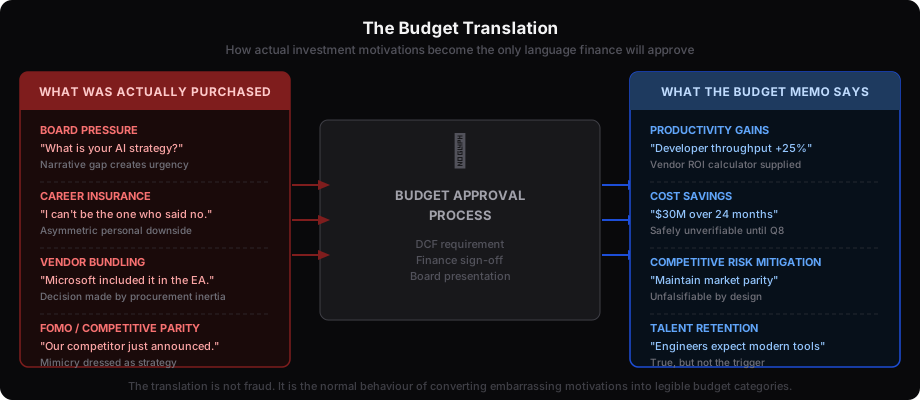
The people approving these budgets are not confused about their real motivations. They are translating those motivations into the vocabulary that the institutional approval process requires.
Enterprise capital allocation processes are built around discounted cash flow logic. Investment goes in, cost savings or revenue growth comes out, the NPV is positive, the investment is approved. The vocabulary of this process is specific: labor efficiency, developer throughput, cost-per-unit reduction, revenue attributable to AI features. Credibility insurance, competitive positioning narrative, and executive career risk management are not DCF inputs. They cannot appear in a budget memo in their raw form.
So the translation happens. The real motivation (“we need to be seen as an AI company by our investors and board”) becomes the budget line: projected developer productivity gains of 25% over 24 months. The real motivation (“I cannot be the CTO who said AI was a distraction when it turned out to be the biggest platform shift since mobile”) becomes the risk mitigation section: competitive displacement risk if peers accelerate adoption.
This is not fraud. It is the normal institutional behavior of converting ambiguous, politically sensitive, or personally embarrassing motivations into the legible categories that financial systems require. Everyone involved understands the subtext. Nobody writes it down.
The vendor platform reinforces this translation. Microsoft, Anthropic, OpenAI, and Google have all built ROI calculators, productivity benchmark decks, and TCO analysis frameworks because that is the paperwork their buyers need to close procurement. The market produces productivity language because productivity language is what converts into signed contracts. No vendor has built a board-narrative value calculator, even though that is what a substantial fraction of their buyers need.
The Asymmetric Career Risk
The specific mechanism driving this is worth naming precisely, because it explains the magnitude of the spending and its persistence across organizations with different operational circumstances.
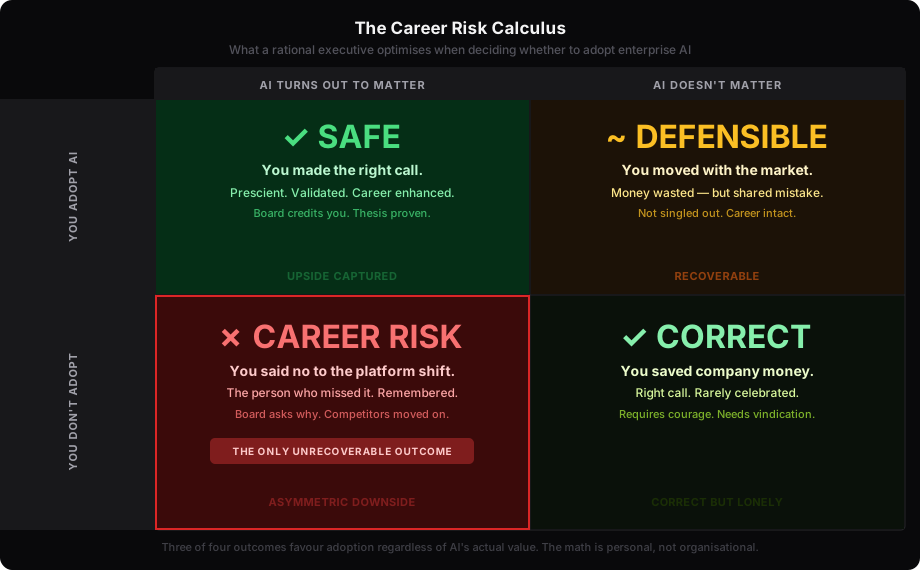
The executive who approves enterprise AI spend faces an asymmetric personal risk structure.
If they approve the spend and AI turns out to be significant: they made a prescient decision. Their judgment is validated. The spend is credited to them.
If they approve the spend and AI turns out not to be significant: the money was wasted, but so was everyone else’s. They moved with the market. It is defensible.
If they do not approve the spend and AI turns out to be significant: they are the person who said no. They are the technology leader who missed the most important platform shift in a generation. This is a career-ending positioning at many organizations.
If they do not approve the spend and AI turns out not to be significant: they saved the company money and were right to be skeptical. This outcome, which requires courage to pursue and luck to be vindicated on, is the only scenario where not spending is unambiguously correct.
The expected-value calculation that a rational executive runs does not require productivity gains to be real. It requires the downside of non-adoption to be worse than the cost of adoption. At current pricing for enterprise AI licenses, and given the current board and investor environment, the downside of non-adoption is substantially worse for most senior executives than the cost of the spend. The spend is individually rational even if it is organizationally wasteful.
This is not a moral failing. It is the predictable output of an incentive structure in which the people making spending decisions bear asymmetric personal risk, and the currency of that risk is not company money but professional reputation.
Where Cost Savings Is Real
The cost savings case is genuine in a specific, narrow, auditable set of circumstances, and it is worth preserving instead of letting it get buried under the broader critique.
When the task is high-volume, low-variance, and previously staffed by workers paid above the AI marginal cost per unit: the economics work and the causal chain is short. Tier-1 customer back deflection with measurable ticket volume and handle time. Contract review triage where the classification task is well-defined. Document extraction from structured PDFs where the output can be validated against a ground truth. In these workflows, AI can execute at a fraction of the prior labor cost, the quality can be audited, and the headcount impact can be tracked.
These are real gains. Companies like Klarna have documented them in specific operational contexts. The GitHub Copilot studies showing 20-55% faster completion of bounded coding tasks reflect something real in the narrow category of tasks they were measuring.
The problem is not that these gains do not exist. The problem is that they account for a small fraction of total enterprise AI spending, they exist in specific workflows instead of across broad organizational deployments, and they are being used as the evidentiary basis for spending decisions that extend far beyond the conditions under which the gains were demonstrated.
The narrow task automation case is real. It is not the reason most enterprise AI was purchased.
The Measurement Debate Is Asking the Wrong Question
The researchers who find weak AI productivity evidence, the analysts who question whether AI is delivering ROI, and the executives who quietly acknowledge the numbers are hard to make work: they are not wrong. They are measuring the right thing for a different purchase than the one that was made.
You cannot measure the ROI of an executive’s career insurance policy. It was not purchased for ROI. The value it delivers is the elimination of personal downside risk, and that value is delivered immediately upon purchase, the moment the board meeting has an answer to “what is your AI strategy.” Whether developers are 25% more productive 24 months from now is irrelevant to whether the purchase accomplished its actual purpose.
This means the productivity measurement debate, conducted entirely on its own terms, is structurally unresolvable. The evidence will always be mixed because the investment was always mixed: some genuine task automation, some valuation narrative, some talent signaling, and a substantial portion of career insurance that was never going to appear in a productivity metric.
The sharper question is not: are AI productivity gains real? The sharper question is: which fraction of AI spending was ever intended to produce measurable productivity gains, and is that fraction being measured rigorously? The answer to the second question, for almost every organization currently spending at scale, is: almost never. Which makes the debate about evidence for a claim that most buyers were never making.
What Honest Accounting Would Look Like
Naming the actual investment thesis does not require executives to confess bad faith. It requires separating the portfolio.
Not all AI spending is the same kind of bet. A Copilot license distributed to knowledge workers is a legitimacy and retention insurance purchase. A fine-tuned model embedded in a customer-facing workflow is a revenue bet. An AI-powered compliance monitoring system is a risk mitigation purchase. An API sandbox given to an R&D team is an option purchase on unknown future value. These belong in different budget categories with different success criteria and different review timelines.
Organizations that track all of it as “AI investment” with a single productivity ROI target are not measuring any of it correctly. They are applying a continuous financial framework to a portfolio of structurally different bets, several of which are not continuous financial bets at all.
The ones that are cost savings bets should have baselines. The ones that are legitimacy bets should be reviewed once (did it clear the threshold?) and not funded for continuous ROI reporting. The ones that are optionality bets should be reviewed against capability development, not output metrics. The risk mitigation bets should be reviewed in the same format as insurance: annually, against whether the feared scenario materialized and whether the capability gap closed.
If an organization is not willing to build the measurement infrastructure appropriate to the actual investment thesis, including the politically uncomfortable step of naming the thesis, it should stop expecting the productivity measurement to make the spending legible. It will not. It was never designed to.
The productivity measurement problem is not a methodology problem. It is a honesty problem. And the organizations that solve the honesty problem first will make better AI investment decisions than the ones still arguing about which productivity metric is least flawed.
If you are trying to build an AI investment framework that reflects what you are buying, start with a free assessment.